Sentioscope

Speech and voice controls, as each vendor documents them

What Vidu documents about speech

Vidu (platform.vidu.com) documents native audio on Q3 covering speech, sound effects and music, switched on by default in the API, with a mode that returns speech alone. As of 2026-09-12.

Controls documented, model by modelFilled where the model documents that control, hollow where nothing is published about it.Controls documented, model by modelWhat the vendor documentsWhat the vendordocumentsAudio sourceAudio source — What the vendor documents: Q3 generates speech, effects and music natively, on by defaultLanguagesLanguages — What the vendor documents: Not documentedVoice sourceVoice source — What the vendor documents: Not documentedPer-character bindingPer-character binding — What the vendor documents: Not documentedLip-syncLip-sync — What the vendor documents: Not documented
Fig. 1 Filled where the model documents that control, hollow where nothing is published about it.
The five fields this register keeps, for Vidu. Read from the vendor's API reference on 2026-09-12.
FieldWhat the vendor documents
Audio sourceQ3 generates speech, effects and music natively, on by default
LanguagesNot documented
Voice sourceNot documented
Per-character bindingNot documented
Lip-syncNot documented

Inclusion rule. Fields are the same five for every model here; a field the vendor does not document is recorded as not documented rather than inferred from generated output. Order. Fixed field order, identical on every model page.

1A default that decides what most output sounds like

Audio being on by default is a small sentence with a large effect. Every call made without reading the parameter list returns a clip with sound, which means the baseline output of this model is a finished soundscape rather than a silent picture waiting for post. A team measuring the model against a silent competitor is not comparing like with like.

The speech-only mode is the counterpart and the more useful one for drama: it separates the line from the effects and music, so dialogue can be kept while the bed is replaced. No other model in this register documents that separation.

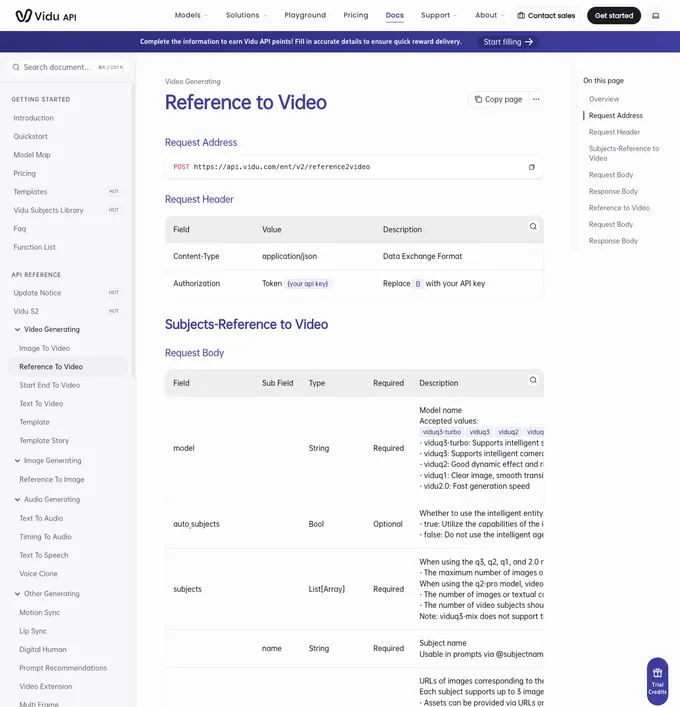
The Vidu reference-to-video documentation as it appeared on 16 September 2026.
Fig. 2 The same reference page that carries this model's audio statement, written for a developer calling the endpoint rather than for a production.Screenshot of platform.vidu.com/docs/reference-to-video, captured 2026-09-16. Reproduced to show where this entry was read from.

2Everything about the voice itself is unstated

Four of the five fields this register keeps are empty here. No language list or count, no statement about where a voice comes from, no way described to hold a voice to a character, and nothing on lip-sync. The API reference describes what is produced and not who is speaking.

For a single clip that is enough. For a series it leaves the central question open, because a cast that is re-drawn on every call is not a cast. This site records the gap rather than filling it from listening tests, which would be an opinion about output rather than a published fact.

3This entry, one column at a time

Each of these stays inside a single field: what Vidu puts there, what the wording settles, and what it leaves for a take to answer.

  • Audio source — with the picture, speech available on its own.

4Read against another entry

Each of these puts Vidu beside one other entry on a column where the two land at opposite grades of answer.

5Where this model sits against the rest

Audio source, across every model hereOne field at a time, every entry side by side, with Vidu marked. The full wording for every cell is in the rows below. This entry was read 2026-09-12.Audio source, across every model hereAudio sourceD-IDD-ID — Audio source: A text script read aloud, or an audio url suppliedHedraHedra — Audio source: Supplied; audio is a required inputHeyGenHeyGen — Audio source: A text to speech endpoint, apart from the pictureKling AIKling AI — Audio source: Generated with the picture, VIDEO 3.0LTX StudioLTX Studio — Audio source: Generated jointly with the picture, plus audio-to-videoLuma RayLuma Ray — Audio source: Not documented; the video reference does not mention soundMiniMaxMiniMax — Audio source: Native speech, generated with the picturePixVersePixVerse — Audio source: Supplied to a speech endpoint, or read from text thereRunwayRunway — Audio source: Not documented where voices are definedSceneMixerSceneMixer — Audio source: Generated with the picture, in the language set for the projectSora 2Sora 2 — Audio source: Generated with the picture; video and audio are both listed as outputsync-3sync-3 — Audio source: Supplied, or read from text on the callSynthesiaSynthesia — Audio source: Synthesised from the script, or an uploaded recordingVeoVeo — Audio source: Generated with the video rather than added afterwardsViduVidu — Audio source: Q3 generates speech, effects and music natively, on by defaultWan 3.0Wan 3.0 — Audio source: On by default; false returns a file with no audio trackWan2.2-S2VWan2.2-S2V — Audio source: Supplied; the card describes the model as audio-driven
Fig. 3 One field at a time, every entry side by side, with Vidu marked. The full wording for every cell is in the rows below. This entry was read 2026-09-12.
Every entry in this register on the same field, with Vidu marked. Each cell carries the reading date of its own entry; this one was read 2026-09-12.
ModelAudio source
D-IDA text script read aloud, or an audio url supplied
HedraSupplied; audio is a required input
HeyGenA text to speech endpoint, apart from the picture
Kling AIGenerated with the picture, VIDEO 3.0
LTX StudioGenerated jointly with the picture, plus audio-to-video
Luma RayNot documented; the video reference does not mention sound
MiniMaxNative speech, generated with the picture
PixVerseSupplied to a speech endpoint, or read from text there
RunwayNot documented where voices are defined
SceneMixerGenerated with the picture, in the language set for the project
Sora 2Generated with the picture; video and audio are both listed as output
sync-3Supplied, or read from text on the call
SynthesiaSynthesised from the script, or an uploaded recording
VeoGenerated with the video rather than added afterwards
ViduQ3 generates speech, effects and music natively, on by default
Wan 3.0On by default; false returns a file with no audio track
Wan2.2-S2VSupplied; the card describes the model as audio-driven

Inclusion rule. Models whose vendor documents something about generated speech. A model with nothing published on the point is still listed, with the cell marked hollow. Order. Alphabetical by model name.

Languages, across every model hereOne field at a time, every entry side by side, with Vidu marked. The full wording for every cell is in the rows below. This entry was read 2026-09-12.Languages, across every model hereLanguagesD-IDD-ID — Languages: A language field beside the voice; no list on the referenceHedraHedra — Languages: Full multi-language support claimed, none namedHeyGenHeyGen — Languages: Thirty or more, counted on the translation endpointKling AIKling AI — Languages: Five, not namedLTX StudioLTX Studio — Languages: Not documentedLuma RayLuma Ray — Languages: Not documentedMiniMaxMiniMax — Languages: Not documented by the vendorPixVersePixVerse — Languages: Multiple, with speech, singing and advertisements named as typesRunwayRunway — Languages: Not documentedSceneMixerSceneMixer — Languages: 15, named, with Cantonese a 16th for dialogue onlySora 2Sora 2 — Languages: Not documentedsync-3sync-3 — Languages: Ninety-five or more, counted rather than namedSynthesiaSynthesia — Languages: A catalogue, each voice carrying a language name and codeVeoVeo — Languages: Not documentedViduVidu — Languages: Not documentedWan 3.0Wan 3.0 — Languages: Not documentedWan2.2-S2VWan2.2-S2V — Languages: Not documented
Fig. 4 One field at a time, every entry side by side, with Vidu marked. The full wording for every cell is in the rows below. This entry was read 2026-09-12.
Every entry in this register on the same field, with Vidu marked. Each cell carries the reading date of its own entry; this one was read 2026-09-12.
ModelLanguages
D-IDA language field beside the voice; no list on the reference
HedraFull multi-language support claimed, none named
HeyGenThirty or more, counted on the translation endpoint
Kling AIFive, not named
LTX StudioNot documented
Luma RayNot documented
MiniMaxNot documented by the vendor
PixVerseMultiple, with speech, singing and advertisements named as types
RunwayNot documented
SceneMixer15, named, with Cantonese a 16th for dialogue only
Sora 2Not documented
sync-3Ninety-five or more, counted rather than named
SynthesiaA catalogue, each voice carrying a language name and code
VeoNot documented
ViduNot documented
Wan 3.0Not documented
Wan2.2-S2VNot documented

Inclusion rule. Models whose vendor documents something about generated speech. A model with nothing published on the point is still listed, with the cell marked hollow. Order. Alphabetical by model name.

Voice source, across every model hereOne field at a time, every entry side by side, with Vidu marked. The full wording for every cell is in the rows below. This entry was read 2026-09-12.Voice source, across every model hereVoice sourceD-IDD-ID — Voice source: A voice id from one of five named speech providersHedraHedra — Voice source: An uploaded track, or a voice id from the voices endpointHeyGenHeyGen — Voice source: A clone, instant from one recording or professional from 20 minutes or moreKling AIKling AI — Voice source: Not documented by the vendorLTX StudioLTX Studio — Voice source: Not documentedLuma RayLuma Ray — Voice source: Not documentedMiniMaxMiniMax — Voice source: Reference audio, 15 s total across 3 clipsPixVersePixVerse — Voice source: Built-in voices, or a custom voice from a supplied sampleRunwayRunway — Voice source: An audio sample of 10 seconds to 5 minutes, or a description in wordsSceneMixerSceneMixer — Voice source: Preset voice library, or the user's own recordingsSora 2Sora 2 — Voice source: Not documentedsync-3sync-3 — Voice source: Not documented on the model pageSynthesiaSynthesia — Voice source: The catalogue, or a cloned voice with a language list of its ownVeoVeo — Voice source: Not documentedViduVidu — Voice source: Not documentedWan 3.0Wan 3.0 — Voice source: Reference audio, 15 seconds in total, WAV or MP3 up to 15 MBWan2.2-S2VWan2.2-S2V — Voice source: Whatever track is handed over; no catalogue
Fig. 5 One field at a time, every entry side by side, with Vidu marked. The full wording for every cell is in the rows below. This entry was read 2026-09-12.
Every entry in this register on the same field, with Vidu marked. Each cell carries the reading date of its own entry; this one was read 2026-09-12.
ModelVoice source
D-IDA voice id from one of five named speech providers
HedraAn uploaded track, or a voice id from the voices endpoint
HeyGenA clone, instant from one recording or professional from 20 minutes or more
Kling AINot documented by the vendor
LTX StudioNot documented
Luma RayNot documented
MiniMaxReference audio, 15 s total across 3 clips
PixVerseBuilt-in voices, or a custom voice from a supplied sample
RunwayAn audio sample of 10 seconds to 5 minutes, or a description in words
SceneMixerPreset voice library, or the user's own recordings
Sora 2Not documented
sync-3Not documented on the model page
SynthesiaThe catalogue, or a cloned voice with a language list of its own
VeoNot documented
ViduNot documented
Wan 3.0Reference audio, 15 seconds in total, WAV or MP3 up to 15 MB
Wan2.2-S2VWhatever track is handed over; no catalogue

Inclusion rule. Models whose vendor documents something about generated speech. A model with nothing published on the point is still listed, with the cell marked hollow. Order. Alphabetical by model name.

6Sources

Taken from the API reference at platform.vidu.com on 2026-09-12. Every entry against the same five fields sits on the speech controls page; the rule behind each field is on how read. The entries either side of this one: Wan 3.0, Wan2.2-S2V.

  • Audio source
    Q3 outputs speech, sound effects and music natively, on by default in the API, with a speech-only modethree tracks in one passVidu, API reference / recorded 2026-09-12
  • Per-character binding
    Not documented by the vendor (as of 2026-09-12)no public descriptionVidu, API reference / recorded 2026-09-12